Thursday, May 6, 2010

The Sunday Times Sport Rich List: Racing drivers have formula to build fortunes

Footballers dominate the first Sport Rich List but the big money is made behind the wheel of an F1 car

You might expect the the richest sports people in the country to be footballers followed by golfers. Wrong.

The first definitive list of the wealthiest sporting stars in Britain and Ireland, published in the Sunday Times today, shows that motor racing dominates the top 15 places. If you want to get seriously rich in sport, get driving, preferably fast cars not little white balls.

True, top of the first Sunday Times Sport Rich List are two men who kick, or used to kick, a leather ball about the park. Dave Whelan has come a long way since he broke his leg while playing for Blackburn Rovers in the 1960 FA Cup final. Though Rovers lost 3-0 and the injury put Whelan’s career into decline, he used the £400 compensation he received to start a discount store. He went on to make a £190m fortune from the JJB chain of sports shops.

In second place is a footballer who manages to combine business with playing in a way no other British star can rival: David Beckham. His many sponsorships outstrip his earnings as a player to take his fortune to £125m.

Follow England in the World Twenty20

To launch Hawk-Eye, click here.

Follow England's progress in the World Twenty20 with our unbeatable live coverage.

Regular readers of these pages will know that Hawk-Eye provides the most detailed statistical cricket analysis online. Updated as the match progresses, its many features include animations of crucial deliveries, wagon wheel graphics illustrating a batsman's shots, pitch maps and bee hives depicting bowlers' line and length.

You can also test your powers of analysis against other readers in our predictor game and post your thoughts in our forum.The service is available on mobile phones, too. To receive the live scores and commentary, go to http://m.pulselive.com on your phone's browser or text the word CRICKET to 87700 for a link to our cricket page, then follow the link to the live commentary. Otherwise, click here to launch the Hawk-Eye scoreboard on your computer now.

Source:The Times

Wednesday, April 28, 2010

Shaken Roger Federer vows to bounce back from shock defeat by Ernests Gulbis

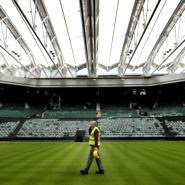
No sooner had he helped to cut the ribbon for the official opening of the towering new Centre Court at the Foro Italico yesterday than Roger Federer became its first conspicuous victim.
For the first time in seven visits here since he assumed the world No 1 ranking, Federer was hurried from the scene at the BNL d’Italia Masters as Latvia’s Ernests Gulbis reannounced himself as a class act.
Only last month, British tennis was lamenting the progress of Lithuania as a force as the Balkan nation won a Davis Cup tie between the countries, a result that cost the captain, John Lloyd, his job, prompted a review of priorities at home and was cited as one of the reasons why Andy Murray’s game suddenly went Awol. The signs last night were that Murray’s recovery process has begun with a vengeance, an emphatic 6-2, 6-4 first-round victory over Andreas Seppi, of Italy, halting a run of three consecutive defeats.
Murray served with particular aplomb to secure his place in the third round; Gulbis produced a succession of bullet-like deliveries that peppered Federer’s defences. The 21-year-old — ranked outside the top 100 last September — has recovered his teenage poise, surged to No 40 and his 2-6, 6-1, 7-5 victory as thunder rumbled, will cause the Swiss to stop and think about what he must do on clay to add to his 16-strong grand slam title collection when he starts the defence of his French Open crown in 3½ weeks.
If anyone can do it, Federer can. He is the master of compartmentalising defeats, steadying the ship and turning on the grace and style when it really matters, in best-of-five-set occasions. It was clear from watching him practise that the Swiss was loose and apparently unconcerned that he was shanking so many routine shots. Although he sped through the first set, the minute Gulbis sharpened his range-finder, he took great delight in imposing his game on the world’s best.
Gulbis needed seven match points to secure victory, six being squandered in the tenth game with a mixture of outrageously brave serving and monstrous mis-hits. “I was shaking, it was a terrible feeling,” Gulbis said.
But Federer’s serve had been hit and miss throughout the final set and he conceded the advantage Gulbis had given him right back to his opponent. The Latvian then served out to love.
“You cannot be 100 per cent all the time,” Federer said. “Sometimes it takes a loss like this to wake up and shake your mind. It can be that things are too simple, and days like this make you realise how difficult it is to dominate the tour. I didn’t feel safe at any time today, my game wasn’t up to its normal standard. Of course Roland Garros is in the back of my mind but I have two tournaments to get the wins I need. And I’m still in the doubles.”
Once you heard the first “C’mon” from Murray in the opening game against Seppi, there was a sense that his focus, so woolly in Monte Carlo the week before last, had returned. The movement was good, the serve clinical, the double-handed backhand had verve, his whole demeanour was enhanced. A good evening’s work.

Racecourses glimpse the benefit of free enterprise

Alan Lee says that free entry at nine racecourses, this week, challenges the entrenched belief that racing is an extortionate day out

The best ideas can be both simple and daring. Twenty-overs cricket restored innocence and spontaneity to a game suffering from lazy preconceptions that it could last forever and still end in stalemate. Free entry at nine racecourses, this week, challenges the entrenched belief that racing is an extortionate day out.
On early indications, free racing is working in just the way Twenty20 has done - by attracting a previously reluctant audience. This will not only shame those who scorned the initiative as worthless sham, it could also bring an overdue rethink on pricing policies, both in racing and other sports.
Sedgefield shut its gates last night, the little Co Durham track full to its 5,000 capacity for a meeting that drew 600 paying spectators in 2009. Mighty Ascot still has ample space today but is expecting 12,000, a 300 per cent increase on last year. Goodwood, Saturday's free fixture, is already a sell-out.
These are uplifting figures for the Racing For Change (RFC) group, which negotiated the barriers of timid pragmatism in securing enough willing courses to comprise a week of free meetings. Yet the overwhelming response asks more questions than it answers.
Jill Williamson, general manager at Sedgefield, confirms that the bumper crowd yesterday was “nearly all people new to racing - and we're turning plenty more away”. The theme is similar elsewhere. Surely, the something-for-nothing tendency cannot account for so many thousands?
The vast majority must have some interest in racing, even if it has been dormant for a generation or amounts to nothing more than idle curiosity. So the challenge is how to win them back again.
On Monday, I went to Towcester, where free entry was nothing new. The course pioneered the idea six years ago, when the place was a building site and it hardly seemed fair to charge. It was such a success that it continued when the new stand was complete.
Only its two biggest days - Boxing Day and Easter Sunday - now command an entry fee. This quiet Monday card drew 3,400 - 28 per cent up through the RFC marketing. True, Towcester is not like other courses. Independent in every sense, it has neither clogging committees nor demanding shareholders - and Lord Hesketh, its owner, is a self-confessed maverick. Yet there is nothing fanciful or philanthropic about throwing the gates open. The business plan is proven.
Kevin Ackerman, the young and enterprising general manager, explained: “This used to be a loveably run-down place and our locals had stopped coming. By getting people through the door, we can showcase the new facilities. You'll always get the odd freeloader trying to smuggle in a packed lunch but most people are happy to spend once they are inside.
“It has other spin-offs. Not everything is free here and I call it tiered racing. Some may come back to use the restaurants, or book a VIP box as a treat - we have a very good corporate product. Or they might think of us as a wedding venue.”
Final payments on the new stand and stabling are about to be made but Towcester still expects to return a profit of £400,000 this year. Understandably, Ackerman now wonders why other tracks - especially in the netherland of all-weather racing - do not follow its lead.
Sedgefield, certainly, are thinking of more free days. “We're targeting families,” Mrs Williamson said. “If we don't get younger people coming, the sport will disappear.” Even at Ascot, where decimal odds in the betting ring will also be trialled today, there is a sense of wonder about the take-up for free racing.
Up to yesterday morning, 8,500 tickets had gone out and Ascot will not charge any walk-up customers today. Charles Barnett, the chief executive, has a throat infection and little voice. But he still managed to croak two words. “Quite amazing.”
Source:The Times

Open galleries will be free to have their say about Tiger Woods

Tiger Woods has always described St Andrews as one of his favourite places in the world of golf, yet he can expect no special treatment when he attempts in July to add to the two Open Championships he has won there.
Peter Dawson, the chief executive of the R&A, which organises and runs the Open, said yesterday that although spectators will be expected to show respect to the players, they were entitled to express their views.
There has been speculation that Woods might be heckled after revelations about his private life, and Dawson admitted there was little he could do to prevent it. “We’re not a police state,” he said. “People can say what they like.”
Woods has yet to confirm that he will help to celebrate the championship’s 150th year, but it is difficult, now that he has returned to the game after five months away, to think of the oldest of the majors going ahead without him.
While the R&A is keen not to be heavy-handed over security, Dawson pointed out that bad behaviour of spectators would not be tolerated. “If they start putting players off, we’ll have something to say about it,” he said at St Andrews. “They are asked to stop and if they don’t, they are asked to leave.”
Asked if he expected a negative reaction to Woods, whose extra-marital affairs have battered his public image, Dawson took heart from what happened at the Masters three weeks ago. “I don’t think I do, although I could be badly wrong,” he said. “The Augusta fans are people just like everybody else and I think there was genuine relief that Tiger was back. I think the reaction to him was measured. It wasn’t enthusiastic but it wasn’t hugely negative, either. I expect something similar here.
“I remain the biggest fan of his golf game that there could possibly be. I’m just very sad at what has happened and I’m sure that he is, too. I don’t know anybody who saw this coming. It was a great shock to all of us in golf. Let’s hope he returns a stronger person.”
Unlike Billy Payne, the chairman of the Augusta National Golf Club, who criticised Woods, Dawson is not going to express disapproval in public. However, as one of the guardians of the game, he remarked that Woods’s on-course behaviour needs cleaning up. “It had deteriorated,” he said. “No one who has a care for the etiquette of the game could be happy with that and I’m sure Tiger, when he looks at the pictures, isn’t happy with it.
“I thought Billy’s comments were measured and well crafted. He had the disadvantage of being [Tiger’s] first event back.
“The Masters had a major problem in having no idea what to expect. If the Open had been his first back, we’d have been scratching our heads.”
As yet prize money has not been set for this year’s championship and will be dependent, among other things, on the prevailing exchange rates nearer the time. Stewart Cink, the 2009 champion, won £750,000 and Dawson said that the prospect of a £1 million first prize was on the horizon, “but not this year”.
Source:The Times

Wheels falling off for Michael Schumacher

MERCEDES are preparing an extensively modified car for Michael Schumacher to drive at the Spanish Grand Prix in two weeks’ time. This could make or break Schumacher’s so far ill-starred comeback. If the new car doesn’t deliver the characteristics Schumacher says he needs to be competitive, serious doubts will be raised over him seeing out his three-year contract.
After a woeful 10th place in the Chinese Grand Prix, Schumacher reiterated that his car does not let him drive in his natural way. Team boss Ross Brawn explained further: “Our car does not have enough front downforce. New regulations have made the front tyres narrower, which means you need to generate more downforce at the front than before. Michael needs to be able to lean heavily on the front of the car to make his driving style work.”
The modified car is thought to feature a significantly longer wheelbase, allowing the front wheels to be sited further forward in relation to the cockpit. This will speed the airflow along the car, in effect pulling the air over the front wing faster and increasing the downwards thrust upon the front tyres.
Schumacher needs a car that changes direction sharply, which has so far proved elusive with the Mercedes. His attempt at creating that artificially has worsened his problems, if the observations of a former F1 technical director are accurate: “Michael always liked a car with a positive turn-in. He was at his fastest with no understeer. If a car inherently understeers then you can only get it balanced by artificially degrading the rear grip. This means less overall grip and Michael’s car in Shanghai had visibly awful traction, making me suspect that he has screwed up the rear just to try and get it to turn in.”
Whatever the car’s limitations, Schumacher has clearly adapted less well than his teammate Nico Rosberg, who is 17 years younger and has soundly beaten him in all four races so far.
Perhaps the most telling moment came when Lewis Hamilton drove around Schumacher’s outside through the fast turn eight, a move almost unthinkable in the German’s prime.
But it’s probably significant that Schumacher seems to be pinning his hopes on changing the car rather than finding more from himself. He says working on the development of the car is “fun for me”. It will be fun only if the process proves fruitful. His display in the new car in Barcelona may determine if that process ever reaches fruition.
Mark Hughes writes for Autosport magazine

Neil Carter undermines Hampshire with fine spell of swing bowling

Edgbaston (first day of four: Hampshire won toss): Warwickshire, with nine first innings wickets in hand, are 238 runs behind Hampshire

It is not easy to concentrate amid the cacophony of drills, diggers and cement mixers laying the foundation for the £30m redevelopment of the pavilion end at Edgbaston but Michael Carberry, England’s newest opener, and Sean Ervine, the former Zimbabwe all-rounder, got their heads down to lift Hampshire to a total of 283 against Warwickshire.
Carberry, who had scored a double-century, two hundreds and four fifties in his eight previous championship matches against Warwickshire, again showed his liking for their bowling but when he was out for 74 Hampshire were in trouble at 120 for five.
Warwickshire picked two spinners in Imran Tahir, formerly of Hampshire, and Ant Botha but it was Neil Carter who undermined Hampshire with his left arm swing and went on to finish with four for 59 in 23 demanding overs.
Carter had Jimmy Adams caught behind and claimed Chris Benham and James Vince lbw before Darren Maddy, playing his first championship match for a year, picked up the wicket of Neil McKenzie when he was caught at slip.
Carberry, who made his England debut in the first Test against Bangladesh at Chittagong in March, looked the part, scoring his runs off 127 balls with 11 fours and a six, but then he pulled a long hop from Chris Woakes to mid on and left the field shaking his head in annoyance.
Another wicket then and Warwickshire would have been right on top in this contest between two sides who have both lost their first two matches but they simply did not bowl well enough as Ervine joined Nic Pothas in a sixth wicket stand of 83 in 20 overs.
Pothas had scored 47 when he was brilliantly caught at slip by Rikki Clarke off Jonathan Trott and Ervine went on to make 70 before he gave Clarke a more straightforward catch off Imran Tahir.
Kabir Ali and James Tomlinson gave Ervine some support and when Warwickshire went in with 13 overs remaining Kabir soon claimed Westwood for a duck.
Maddy, who had not played since the corresponding game last season because of knee trouble and a nasty facial injury suffered in pre-season practice in South Africa, stood firm, however, and Ian Bell looked in good touch to take Warwickshire to 45 for one by the close.
Hampshire: First InningsM A Carberry c Westwood b Woakes 74J H K Adams c Ambrose b Carter 4C C Benham lbw b Carter 8N D McKenzie c Trott b Maddy 13J M Vince lbw b Carter 6*†N Pothas c Clarke b Trott 15S M Ervine c Clarke b Tahir 70K Ali c Ambrose b Carter 16J A Tomlinson c Tahir b Woakes 29D R Briggs b Tahir 0D A Griffiths not out 0Extras (b 4, lb 10, nb 2) 16Total (80.5 overs) 283
Fall of wickets: 1-6, 2-18, 3-61, 4-84, 5-120, 6-203, 7-238, 8-273, 9-273.
Bowling: Woakes 16.5-4-60-2; Carter 23-6-59-4; Maddy 17-3-53-1; Clarke 6-0-32-0; Trott 8-1-29-1, Tahir 8-0-23-2; Botha 2-0-13-0.
Warwickshire: First Innings*I J Westwood lbw b Ali 0D L Maddy not out 21I R Bell not out 17Extras 0Total (1 wkt, 13 overs) 45
I J L Trott, J O Troughton, †T R Ambrose, R Clarke, C R Woakes, N M Carter, A G Botha and Imran Tahir to bat.
Fall of wicket: 1-2.
Bowling: Ali 5-3-9-1; Tomlinson 5-1-15-0; Ervine 1-0-5-0; Griffiths 1-0-7-0; McKenzie 1-0-2-0.
Umpires: M R Benson and P J Hartley.
Source:The Times

search the web

http://sportsdesks.blogspots.com" id="cse-search-box">